
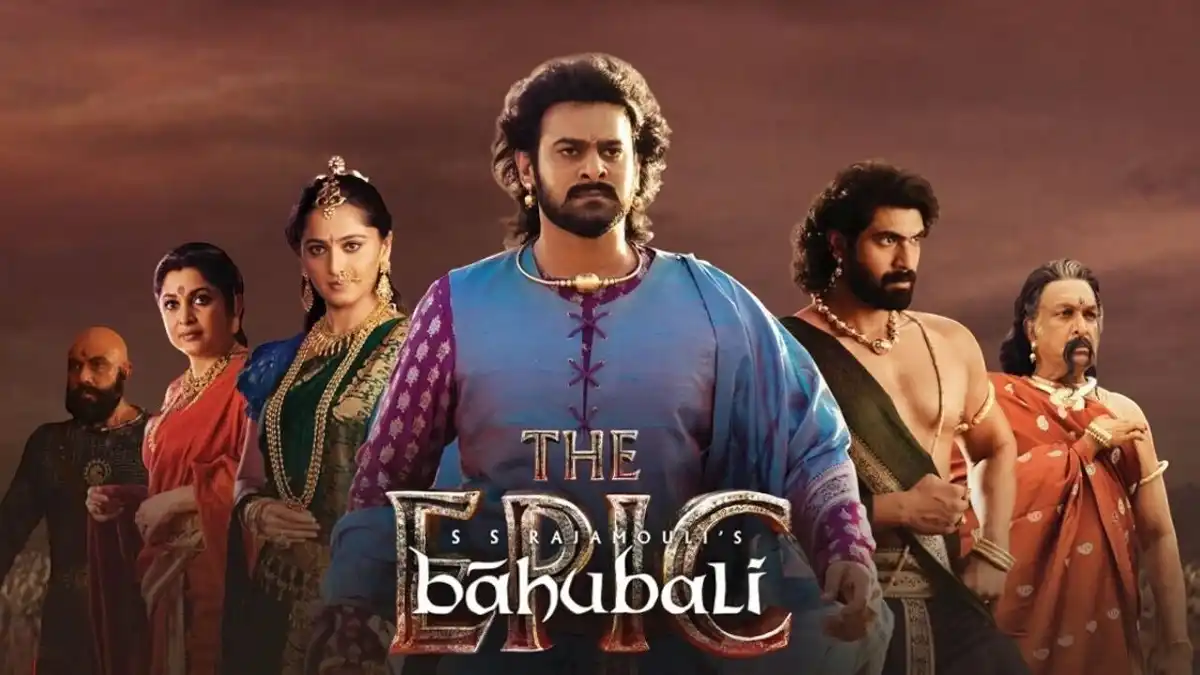
After the pandemic, Telugu cinema discovered itself using a curious wave of re-releases. From nostalgic favourites to cult blockbusters, many movies returned to theatres. Some failed to attach once more, whereas others pulled off nice surprises.
Now, the maverick director SS Rajamouli, the man who redefined Indian cinema with Baahubali, has joined this pattern in his personal ingenious means. As an alternative of merely re-releasing Baahubali: The Starting (2015) and Baahubali: The Conclusion (2017), he mixed each elements into one grand movie titled “Baahubali: The Epic.”
This new model, which premiered final evening throughout the globe, runs near 4 hours. Greater than the runtime, it’s the expertise that feels completely different, acquainted but surprisingly contemporary. Rajamouli trimmed, rearranged, and restructured scenes, turning two monumental chapters into one unified narrative meant to offer audiences, each outdated and new, a seamless journey by means of Mahishmathi.
Why Rajamouli Is Nonetheless Known as “Jakkanna”:
Rajamouli earned the title Jakkanna due to his relentless obsession with element. He by no means takes the viewers without any consideration, even when he is aware of they already adore his work.
That reveals proper from the begin. The title card of Baahubali: The Epic is just not a reused graphic; it’s newly designed with symbolic imagery that celebrates the saga itself. It’s his means of claiming, “You could know the story, however you have got by no means seen it like this.” That is the place you realise as soon as once more why individuals name him a madman in terms of cinema.
A Recent Starting:
Gone is the elaborate prologue that when detailed the kingdoms surrounding Mahishmathi. Rajamouli now begins the story extra intimately with Sivagami (Ramya Krishna) rising from a secret cave, carrying the toddler in her arms. The haunting visuals of her fleeing the troopers, the pressure in her eyes, and her disappearance in the river currents all keep precisely as they have been.
The shift occurs quickly after. The childhood scenes of Shivudu (Prabhas as younger Baahubali) have been rearranged. Rajamouli adjustments the order, exhibiting him lifting the Siva Lingam for his mom (Revathi), then discovering the wood masks, and solely after that asking, “What’s up there, maa?” The reversal provides the sequence a pure thriller, as if the boy’s future is asking earlier than he even asks the query.
This immediately flows into the “Dheevara” music, making a tighter emotional beat. The dialog between Tanikella Bharani and Shivudu’s dad and mom has been fully eliminated.
Avantika’s Arc Retold in a Breath:
The Avantika (Tamannaah) chapter, which initially took practically half-hour, is the most closely altered part. As an alternative of exhibiting her whole journey, Rajamouli replaces it with a voiceover, narrated by himself.
In just a few traces, he explains who Avantika is, what her mission was, how Baahubali met her, fought beside her, and fell in love. The romantic parts and “Pachcha Bottesina” music are gone, but the essence stays.
The iceberg sliding escape sequence is barely shortened, but the transition feels pure. Rajamouli makes the reduce invisible, which is uncommon.
Even Kattappa’s (Sathyaraj) first look, the place he meets Aslam Khan (Kichcha Sudeep), has been eliminated fully.
Mahishmathi and the Rise of Baahubali:
The shift to Mahishmathi occurs quicker now. Scenes that beforehand confirmed the cruelty of Bhallaladeva’s rule are trimmed. The focus is now on the individuals recognizing Baahubali’s return, and the emotional pull of that second lands stronger than earlier than.
The set up of Bhallaladeva’s 100-foot golden idol is shorter, highlighting individuals’s awe as an alternative of pure spectacle. Just a few scenes involving Baahubali’s mom and Avantika are additionally edited out to maintain the narrative clear.
The rescue of Devasena (Anushka Shetty) stays considered one of the standout sequences, although minor pictures like the chariot rising by means of fireplace have been dropped. Rajamouli retains the emotional peaks intact, particularly the highly effective second when Kannappa locations Baahubali’s toes on his head.
The Kalakeya battle sequence follows, barely trimmed in pacing. Some visuals of Kattappa arranging shields and temporary battle preparations are shorter. Nevertheless, Rajamouli maintains the grandeur and depth in order that the viewer by no means senses any loss.
The climactic second of the first movie, the place Kattappa kills Baahubali, now acts as the interval level of Baahubali: The Epic. The interval card humorously reads: “YOU DON’T NEED TO WAIT TWO YEARS TO KNOW WHY KATTAPPA KILLED BAAHUBALI.” It’s a wink at the viewers, playful, sensible, and self-aware.
The Coronary heart of The Conclusion:
The second half begins with a tighter model of The Conclusion. The opening competition that marks Mahishmathi’s custom is trimmed, and the second stanza of “Saahore Baahubali” that includes emotional and battle montages has been eliminated.
The sequence the place Sivagami begins looking for a bride for Amarendra Baahubali additionally loses just a few connective moments. Scenes exhibiting Baahubali and Kattappa wandering by means of the kingdom are reduce for smoother pacing.
Then comes the introduction of Devasena, Queen of Kuntala dynasty. Her entry, the confrontation, and the small battle the place Baahubali and Kattappa playfully combat facet by facet all stay however are barely shortened.
Comedian aid scenes, like Kattappa teasing Baahubali for his dramatic means of expressing love and Kumara Varma’s (Subbaraju) makes an attempt to show his energy, are gone. Rajamouli surprisingly retains the wild boar looking sequence, holding a contact of rural flavour and lightheartedness.
The folks music sung by Kattappa and the lullaby “Kanna Nidurinchara” that includes Anushka have been fully eliminated. Just a few lighter scenes involving Kumara Varma and Baahubali are additionally reduce, and the movie now immediately strikes into critical emotional territory.
Emotion Uncut:
From the second Amarendra Baahubali saves Kuntala Kingdom, the movie barely loses a single emotional beat. The transition to Mahishmathi, his identification reveal, and his relationship with Devasena are all preserved.
Rajamouli trims solely the edges, equivalent to Bijjaladeva’s (Nassar) offended dialogues and Subbaraju’s traces throughout Devasena’s child bathe, whereas making certain the drama and sentiment stay sturdy.
The emotional arc surrounding Amarendra’s loss of life, Sivagami’s guilt, and Mahendra Baahubali’s rise stays totally intact. The last battle sequence between Baahubali and Bhallaladeva is barely tightened. Pictures like Kattappa slapping Bijjaladeva and Baahubali lifting a large tree are shorter, however the energy stays.
As an alternative of finish credit, Rajamouli concludes with a thank-you card, expressing gratitude to everybody who contributed to the making of the Baahubali universe. It’s a small gesture however a considerate one.
What’s Gone and What Stayed:
Most of the cuts come from Baahubali: The Starting, together with Avantika’s arc, the early battle scenes, and comedian bits. Baahubali: The Conclusion largely stays because it carries the emotional coronary heart of the saga with highly effective performances from Prabhas, Rana Daggubati, Ramya Krishna, Anushka Shetty, and Sathyaraj.
Only some songs and lighter interludes have been eliminated to keep up the emotional tempo Rajamouli envisioned.
Rajamouli’s Unique Dream Lastly Realised:
Watching Baahubali: The Epic looks like peeking into Rajamouli’s authentic plan earlier than he determined to separate the story into two elements a decade in the past. Again then, anticipating audiences to take a seat by means of a four-hour movie in India was not real looking. However now, with higher expertise and developed viewing habits, that dream feels achievable.
The movie appears sharper, sounds richer, and flows higher. The visible results maintain up fantastically, and the remastered sound design provides new weight to the epic scale. Each body reminds you of how deeply crafted this world is, from the roar of Mahishmathi’s military to the quiet moments of Devasena’s defiance.
Ultimate Phrase:
Baahubali: The Epic isn’t just a stitched model of two blockbusters. It’s a rigorously rebuilt movie that balances grandeur with emotion and nostalgia with freshness.
Rajamouli revisits his masterpiece with the precision of a craftsman, the coronary heart of a storyteller, and the humility of somebody nonetheless hungry to good his artwork.
This four-hour model looks like the purest type of Baahubali, the one that may have existed in Rajamouli’s thoughts lengthy earlier than it was cut up into two.
In the finish, Baahubali: The Epic is just not merely a re-release. It’s a reaffirmation of why Rajamouli is Jakkanna. The man doesn’t remake; he recreates.